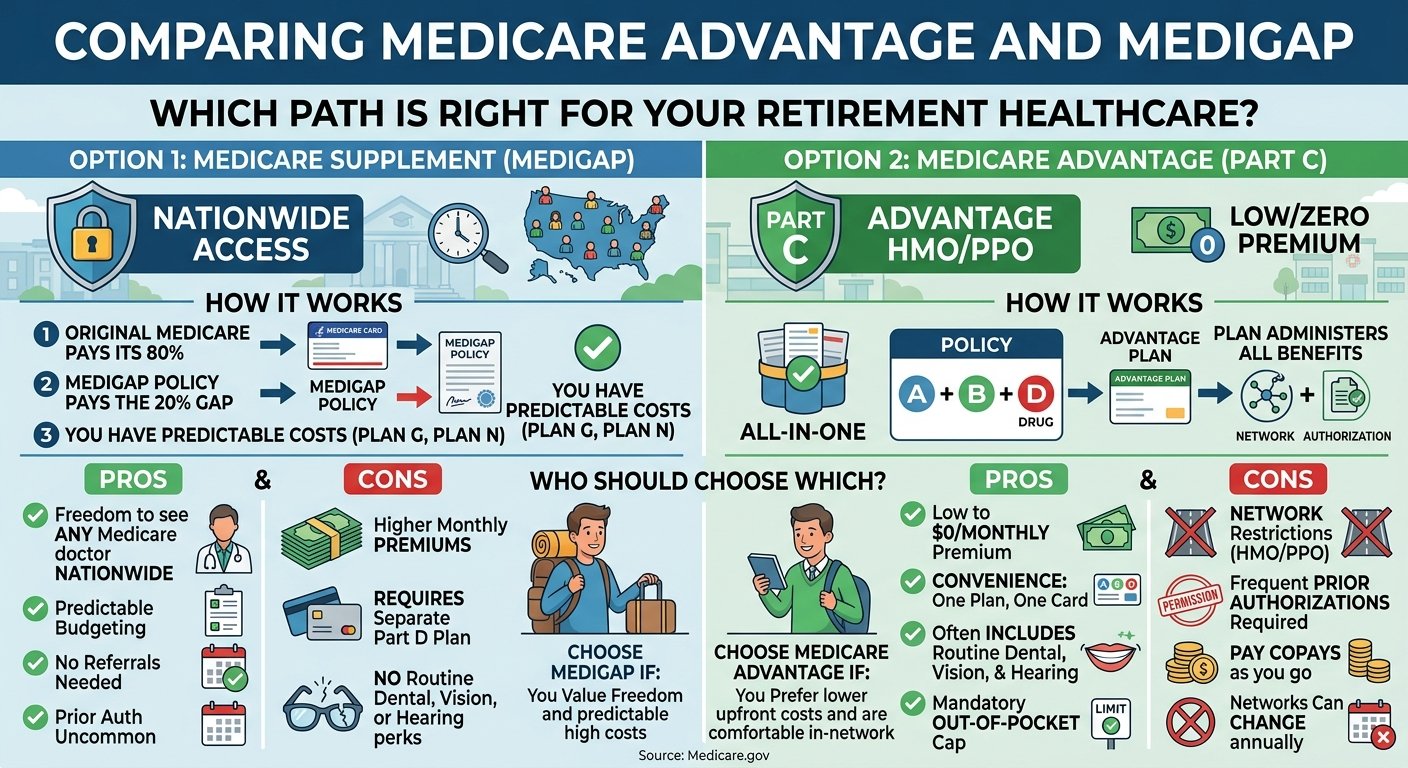
Medicare Advantage vs. Medigap: Pros and Cons List & Comprehensive Guide
Choosing how to receive your Medicare benefits is one of the most significant health and financial decisions you will make in retirement. While every Medicare beneficiary is automatically enrolled in or eligible for Original Medicare (Parts A and B), relying solely on Original Medicare leaves you exposed to unlimited 20% out-of-pocket costs, separate deductibles, and no prescription drug coverage.
To bridge these coverage gaps, beneficiaries must choose between two mutually exclusive paths:
- Medicare Advantage (Part C): A bundled, private-plan alternative that replaces Original Medicare.
- Medigap (Medicare Supplement Insurance): A secondary policy designed to sit on top of Original Medicare to pay for out-of-pocket expenses.
Understanding the pros, cons, structural differences, and cost frameworks of both options will help you select the policy that best fits your healthcare needs and budget.
1. Structural Comparison: How Each Plan Works
Understanding the core mechanics of Medicare Advantage and Medigap is essential before diving into the pros and cons.
                                  ┌── Option 1: Medicare Advantage (Part C)
                                  │    • Bundled All-in-One Private Insurance (HMO/PPO)
                                  │    • Replaces Original Medicare Administration
                                  │    • Network-Restricted Care + Integrated Part D
                                  │
Medicare Decision Path ───────────┤
                                  │
                                  └── Option 2: Original Medicare + Medigap + Part D
                                       • Unrestricted Nationwide Access to Medicare Providers
                                       • Medigap Pays Deductibles, Coinsurance & Copays
                                       • Standalone Part D Prescription Drug Coverage
Medicare Advantage (Part C)
Medicare Advantage plans are managed care policies offered by Medicare-approved private insurance companies. When you enroll in a Medicare Advantage plan:
- You do not lose Original Medicare eligibility, but the private insurance company becomes your primary claims processor.
- Coverage is usually structured as an HMO (Health Maintenance Organization) or PPO (Preferred Provider Organization) network.
- Plans typically bundle Part A (Hospital), Part B (Medical), and Part D (Prescription Drugs) into a single plan card.
Medigap (Medicare Supplement)
Medigap policies are standardized secondary insurance plans offered by private carriers. When you enroll in Medigap:
- You remain directly enrolled in Original Medicare.
- Original Medicare pays its share (typically 80%) of covered services first, and Medigap pays all or most of the remaining costs (deductibles, copays, and 20% coinsurance) depending on the plan letter chosen (e.g., Plan G or Plan N).
- You must purchase a standalone Part D plan for prescription drugs.
2. Pros and Cons Matrix
| Category | Medicare Advantage (Part C) | Medigap (Medicare Supplement) |
| Monthly Premium | Low to $0/month (in addition to Part B) | Moderate to High ($100 to $300+/month) |
| Doctor / Hospital Access | Restricted to local HMO/PPO networks | Nationwide access (Any doctor accepting Medicare) |
| Referrals Required? | Often required for specialists (HMO) | Never required |
| Prior Authorization | Frequent requirement for scans, procedures, and tests | Rare (follows Original Medicare guidelines) |
| Out-of-Pocket Cap | Mandatory annual cap ($9,250 max limit) | No explicit cap needed; expenses are paid upfront by policy |
| Extra Perks (Vision/Dental) | Frequently included (Dental, Vision, Hearing, Gym) | Not included (Requires standalone policies) |
| Travel Coverage | Emergency care only when traveling out of network/state | Full coverage across all 50 US states + foreign emergency care |
3. Medicare Advantage: In-Depth Pros and Cons
Pros of Medicare Advantage
- Low Upfront Costs: Many plans offer $0 monthly premiums, making them appealing to retirees on a fixed income.
- All-in-One Convenience: Medical, hospital, and prescription drug coverages are consolidated into one card and managed by a single carrier.
- Extra Routine Benefits: Often includes supplemental non-Medicare benefits like routine dental checkups, eyeglasses, hearing aids, fitness center memberships (SilverSneakers), and over-the-counter allowances.
- Out-of-Pocket Protection: Unlike Original Medicare alone, Medicare Advantage plans feature a legally mandated maximum out-of-pocket (MOOP) limit that caps your annual medical risk.
Cons of Medicare Advantage
- Network Restrictions: You are restricted to local networks. Out-of-network care may incur high out-of-pocket expenses or be excluded altogether except in emergencies.
- Prior Authorization Hurdles: Insurance plan administrators often require advance approval (prior authorization) before agreeing to cover complex treatments, imaging, or hospital stays.
- Pay-as-You-Go Medical Costs: While monthly premiums are low, you face copays or 20% coinsurance on doctor visits, specialist appointments, diagnostic tests, and inpatient hospital stays until reaching your out-of-pocket maximum.
- Annual Network Changes: Doctor networks, covered drug formularies, and plan structures can change annually during the Annual Enrollment Period.
4. Medigap: In-Depth Pros and Cons
Pros of Medigap
- Complete Freedom of Choice: You can see any specialist or visit any hospital in the United States that accepts Medicare without needing a referral.
- Predictable Healthcare Spending: Plans like Plan G cover virtually all out-of-pocket costs associated with Original Medicare (Parts A & B), leaving you with minimal out-of-pocket surprise expenses beyond the annual Part B deductible.
- No Prior Authorization Delays: Medical decisions are made between you and your doctor. If Original Medicare covers a procedure, your Medigap policy automatically pays its portion without approval delays.
- Guaranteed Renewability: As long as you pay your premium on time, your policy cannot be canceled or changed, regardless of your health status or diagnosis changes.
Cons of Medigap
- Higher Monthly Premiums: Premium costs typically range between $100 and $300+ per month, increasing as you age.
- Separate Prescription Drug Plan Required: You must purchase a standalone Part D policy for medication coverage, adding a second premium and card.
- No Routine Dental, Vision, or Hearing Benefits: Medigap does not cover routine vision exams, dental work, or hearing aids.
- Medical Underwriting After Open Enrollment: Outside of your initial 6-month Medigap Open Enrollment Period (starting when you turn 65 and enroll in Part B), insurance companies can review your medical history and deny coverage or raise premiums due to pre-existing conditions.
5. Financial Comparison & Real-World Cost Model
Baseline cost metrics for Original Medicare:
- Part B Standard Monthly Premium: $202.90/month
- Part B Annual Deductible: $283
The following scenario illustrates how costs compare between Medigap Plan G and a $0-Premium Medicare Advantage Plan during a medical year that includes specialist consultations, diagnostic imaging, and an outpatient surgical procedure.
                  FINANCIAL COST SCENARIO (MODERATE MEDICAL YEAR)

 ┌─────────────────────────────────────────────────────────────────────────────┐
 │ MEDIGAP PLAN G                                                              │
 │                                                                             │
 │ [Part B Premium: $202.90/mo] + [Plan G Premium: ~$150/mo]                   │
 │                                  │                                          │
 │                                  ▼                                          │
 │                     [Part B Deductible: $283]                               │
 │                                  │                                          │
 │                                  ▼                                          │
 │                    TOTAL OUT-OF-POCKET COSTS = $0                           │
 └─────────────────────────────────────────────────────────────────────────────┘

 ┌─────────────────────────────────────────────────────────────────────────────┐
 │ MEDICARE ADVANTAGE ($0 Premium Plan)                                        │
 │                                                                             │
 │ [Part B Premium: $202.90/mo] + [Plan C Premium: $0/mo]                      │
 │                                  │                                          │
 │                                  ▼                                          │
 │ [Primary Care + Specialist Copays] + [CT/MRI Scans] + [Outpatient Surgery]  │
 │                                  │                                          │
 │                                  ▼                                          │
 │                    ESTIMATED COPAYS = $1,800 - $3,500                       │
 └─────────────────────────────────────────────────────────────────────────────┘
Scenario Analysis
- Under Medigap Plan G: You pay a higher fixed monthly cost up front ($150/month premium + Part B premium), but when receiving care, your only out-of-pocket cost for covered services is the $283 Part B deductible.
- Under Medicare Advantage: You save on monthly premiums upfront, but pay dynamic copays and coinsurance as you use medical services. In years with minimal care, Medicare Advantage saves money. In years with extensive care, Medigap generally offers stronger protection against high bills.
6. Decision Matrix: Which Option Fits You Best?
                        Decision Matrix
                               │
       ┌───────────────────────┴───────────────────────┐
       ▼                                               ▼
Choose Medicare Advantage If:                  Choose Medigap If:
• You want low/zero monthly premiums           • You value unrestricted provider choice
• You are comfortable in-network               • You travel interstate frequently
• You want integrated dental & vision          • You prefer predictable medical costs
• You rarely require specialized care          • You want to avoid prior authorizations
You Should Choose Medicare Advantage If:
- You prioritize low fixed monthly expenses and are comfortable paying copays when you visit the doctor.
- Your preferred doctors, specialists, and regional hospital systems are already in the plan’s network.
- You value having routine dental, vision, hearing, and wellness benefits bundled into one plan.
- You reside in a fixed location year-round and do not travel extensively across different states.
You Should Choose Medigap If:
- You want the freedom to choose any doctor or hospital nationwide without network limitations or referrals.
- You travel frequently, live in multiple states throughout the year (e.g., snowbirds), or want access to specialized treatment centers nationwide.
- You prefer predictable healthcare budgeting and want to avoid surprise copays or out-of-pocket medical bills.
- You have chronic medical conditions that require frequent physician visits, testing, or ongoing specialist care.
Summary Checklist
- Coverage Type: Medicare Advantage replaces Original Medicare administration; Medigap supplements Original Medicare.
- Rule on Dual Enrollment: Federal law strictly prohibits holding both a Medicare Advantage plan and a Medigap policy simultaneously.
- Prescription Drug Protection: Medigap requires a separate Part D policy; Medicare Advantage usually includes Part D.
- Enrollment Timing: Apply for Medigap during your 6-month Medigap Open Enrollment Period to avoid medical underwriting questions or rate penalties.