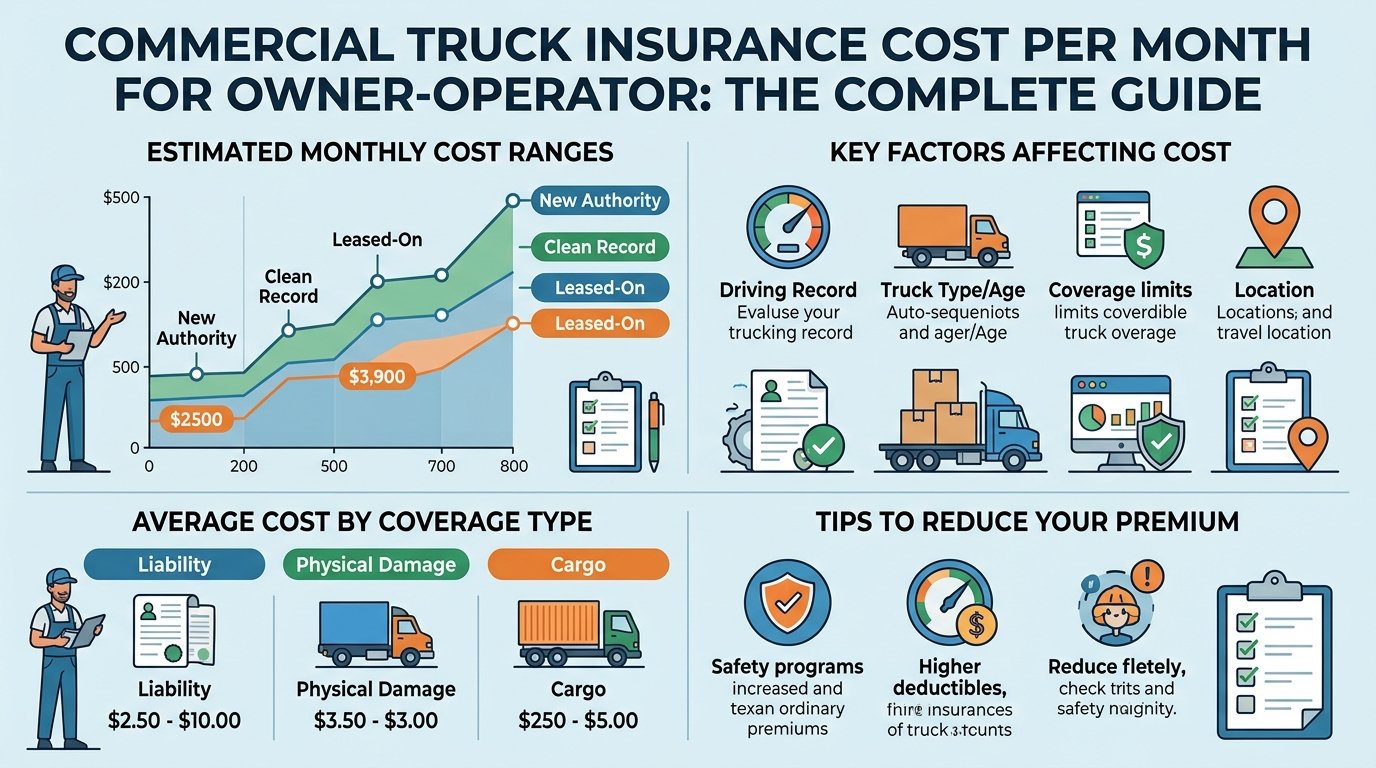
Commercial Truck Insurance Cost per Month for Owner-Operator: The Complete Guide
For independent owner-operators and small fleet owners in the trucking industry, commercial truck insurance is typically the single largest operating expense after fuel. Understanding how much insurance costs, what drives those rates, and how to structure your policy can mean the difference between a profitable operation and running at a loss.
On average, commercial truck insurance for an owner-operator ranges from $800 to $2,000+ per month per truck, translating to an annual cost of $9,600 to $24,000+. However, exact monthly premiums vary wildly based on whether you operate under your own DOT authority or are leased on to a motor carrier, what cargo you haul, and your driving history.
This comprehensive guide breaks down average monthly insurance costs, required coverage types, key rate factors, real-world cost scenarios, and practical strategies to reduce your monthly premium.
1. Average Commercial Truck Insurance Cost per Month
Commercial truck insurance costs depend heavily on your operating structure:
                          Owner-Operator Operating Structure
                                         │
          ┌──────────────────────────────┴──────────────────────────────┐
          ▼                                                             ▼
  Leased-On Owner-Operator                                 Independent Owner-Operator
(Operating under carrier's DOT authority)                     (Operating under own DOT authority)
   $250 – $600 / month                                         $1,000 – $2,200+ / month
Monthly Cost Breakdown by Authority & Experience
| Owner-Operator Profile | Average Monthly Cost | Average Annual Cost | Primary Risk & Cost Factors |
| Leased-On Owner-Operator | $250 – $600 | $3,000 – $7,200 | Carrier covers primary liability; driver buys non-trucking/bobtail & physical damage. |
| Independent (3+ Years Clean Authority) | $950 – $1,500 | $11,400 – $18,000 | Established safety record, steady primary liability rates. |
| New Authority (New CDL / First-Year) | $1,500 – $2,500+ | $18,000 – $30,000+ | High actuarial risk; new authority surcharges apply in year one. |
| Hazmat / Specialized Hauler | $1,600 – $2,800+ | $19,200 – $33,600+ | Higher regulatory liability requirements ($1M–$5M limits). |
2. Core Coverage Components Making Up Your Monthly Premium
A standard commercial truck insurance policy is not a single coverage—it is a bundle of several distinct protections required by federal regulators (FMCSA), lenders, and freight brokers.
                                  ┌── Primary Auto Liability (Federal Mandatory: $750k–$1M)
                                  │
                                  ├── Physical Damage (Comprehensive & Collision for rig)
Commercial Truck Policy Bundle ───┼── Motor Truck Cargo ($100k broker standard)
                                  │
                                  ├── Non-Trucking / Bobtail Liability (For leased-on drivers)
                                  │
                                  └── General Liability & Occupational Accident
1. Primary Auto Liability Coverage
- Mandatory Status: Required by the Federal Motor Carrier Safety Administration (FMCSA).
- Required Limit: Minimum $750,000 for general freight; $1,000,000 standard required by most brokers; $5,000,000 for hazardous materials.
- Monthly Cost:$500 – $1,200/month (accounts for 50%–60% of your total insurance bill).
- What It Covers: Bodily injury and property damage caused to third parties in an at-fault accident.
2. Physical Damage Coverage
- Mandatory Status: Required by lenders if your truck is financed or leased.
- Rate Structure: Typically priced as a percentage (2%–4%) of the truck and trailer’s Stated Amount / Actual Cash Value (ACV).
- Monthly Cost:$150 – $450/month.
- What It Covers: Repair or replacement costs for your tractor and trailer due to collisions, rollover, fire, theft, vandalism, or extreme weather.
3. Motor Truck Cargo Insurance
- Mandatory Status: Required by freight brokers and shippers before loading.
- Standard Limit: $100,000 per load is industry standard.
- Monthly Cost:$100 – $300/month.
- What It Covers: Loss, damage, or theft of the freight you are transporting.
4. Non-Trucking Liability (NTL) / Bobtail Insurance
- Who Needs It: Essential for leased-on owner-operators.
- Monthly Cost:$35 – $90/month.
- What It Covers: Liability protection when driving the truck for personal use or driving without a trailer attached (bobtailing) while off-duty.
5. Commercial General Liability (CGL)
- Monthly Cost:$50 – $120/month.
- What It Covers: Non-driving liability claims, such as slip-and-fall accidents at loading docks, damage caused at client premises, or erroneous delivery claims.
3. Top Factors Influencing Your Monthly Insurance Rates
Underwriters use actuarial algorithms to calculate your truck insurance premium. Understanding these factors helps you identify where you can cut costs:
                   Key Insurance Rate Drivers
                               │
  ┌───────────────┬────────────┴───────────┬───────────────┐
  ▼               ▼                        ▼               ▼
Driving       DOT Authority            Operating        Equipment
Record (MVR)   Age / History             Radius           Value & Type
- Commercial Driving Experience & MVR: A clean Motor Vehicle Record (MVR) with zero speeding tickets, preventable accidents, or violations over a 3-year period yields the lowest rates.
- Age of DOT Authority: Insurers view a brand-new DOT authority as high risk. Insurance costs drop significantly after completing Year 1 and Year 3 without violations.
- Operating Radius: Local haulers (under 100 miles) pay less than regional drivers (100–500 miles). Long-haul, cross-country interstate drivers pay the highest premiums due to fatigue and higher mileage exposure.
- Cargo Type: Transporting dry van general freight carries lower insurance costs compared to auto haulers, reefer units, hazmat cargo, or oversized heavy equipment.
- Garaging Location: Rates vary widely by state and zip code. States with dense traffic, high litigation rates, and harsh winter weather (e.g., Florida, Texas, Louisiana, New York) feature higher insurance rates than states like Iowa, Wyoming, or North Dakota.
4. Real-World Monthly Cost Scenarios
To illustrate how these variables combine in real life, review these three owner-operator profiles:
                           COST COMPARISON BY OPERATOR PROFILE

 ┌─────────────────────────────────────────────────────────────────────────────┐
 │ PROFILE A: Leased-On Owner-Operator (2020 Freightliner Cascadia)            │
 │ • Non-Trucking Liability: $50/mo                                            │
 │ • Physical Damage ($85k Value): $220/mo                                     │
 │ • Occupational Accident: $140/mo                                            │
 │   TOTAL: ~$410 / MONTH                                                      │
 └─────────────────────────────────────────────────────────────────────────────┘

 ┌─────────────────────────────────────────────────────────────────────────────┐
 │ PROFILE B: Experienced Independent (5 Years Authority, Clean MVR, Dry Van)  │
 │ • Primary Liability ($1M Limit): $700/mo                                    │
 │ • Physical Damage ($110k Value): $280/mo                                    │
 │ • Cargo ($100k Limit) + General Liability: $180/mo                          │
 │   TOTAL: ~$1,160 / MONTH                                                    │
 └─────────────────────────────────────────────────────────────────────────────┘

 ┌─────────────────────────────────────────────────────────────────────────────┐
 │ PROFILE C: New Authority Independent (1st Year Authority, Regional Reefer)  │
 │ • Primary Liability ($1M Limit): $1,350/mo                                  │
 │ • Physical Damage ($130k Value): $380/mo                                    │
 │ • Cargo ($100k Reefer breakdown): $270/mo                                   │
 │   TOTAL: ~$2,000 / MONTH                                                    │
 └─────────────────────────────────────────────────────────────────────────────┘
5. Practical Strategies to Lower Your Monthly Premium
While truck insurance is a mandatory cost of doing business, there are concrete steps you can take to lower your monthly bill:
                   Cost-Reduction Roadmap
                             │
  ┌──────────────────────────┼──────────────────────────┐
  ▼                          ▼                          ▼
Increase Deductibles    Install Telematics /    Pay Annually /
 ($1,000 ──► $2,500)      Dashcams (10%-15% off)  EFT Auto-Pay
- Increase Your Physical Damage Deductible: Raising your deductible from $1,000 to $2,500 or $5,000 can lower your monthly physical damage premium by 10% to 25%.
- Install Forward and Driver-Facing Dashcams: Many commercial truck insurers offer direct discounts (5% to 15%) for installing approved dual-facing dashcams and telematics tracking systems (e.g., Samsara, Motive).
- Maintain a Flawless Safety Measurement System (SMS) Score: Keep your FMCSA inspection record clean. Out-of-service (OOS) violations directly inflate renewal premiums.
- Pay Annually or Set Up Auto-Pay: Paying your annual premium upfront eliminates monthly finance charges (interest fees charged by premium finance companies). If paying annually isn’t feasible, setting up automatic bank transfers (EFT) avoids monthly processing fees.
- Shop Around 30–45 Days Before Renewal: Work with an independent commercial truck insurance broker who can query multiple specialized carriers (e.g., Progressive Commercial, Great West Casualty, Canal Insurance, Sentry).
Summary Checklist
- Leased-On Drivers: Expect to pay $250 – $600/month for NTL and Physical Damage.
- Independent Authority: Budget $950 – $2,000+/month for full primary liability, cargo, and physical damage coverage.
- New Authority: Prepare for higher year-one costs ($1,500+/month) until building a proven safety history.
- Key Discount Drivers: Clean MVR, dual dashcams, higher deductibles, and maintaining a high FMCSA safety score.