Cyber Insurance for Law Firms Coverage Requirements: The Complete Guide
Law firms have become top-tier targets for cybercriminals. Because legal practices store highly sensitive client data—including confidential merger and acquisition plans, trade secrets, personally identifiable information (PII), proprietary financial records, and privileged litigation strategies—a single breach can lead to catastrophic financial, legal, and reputational fallout.
However, obtaining cyber insurance for a law firm is no longer as simple as filling out a basic one-page application. In response to skyrocketing ransomware attacks, wire fraud schemes, and third-party vendor breaches, insurance carriers have instituted strict, mandatory coverage requirements. Law firms that fail to meet these technical and operational controls risk higher premiums, severe coverage sublimits, or flat-out policy denials.
This comprehensive guide breaks down the essential coverage requirements for law firms seeking cyber insurance, the core components of policy protection, key risk factors, and actionable steps to ensure your firm qualifies for optimal coverage.
1. Why Law Firms Are Under the Cyber Insurance Microscope
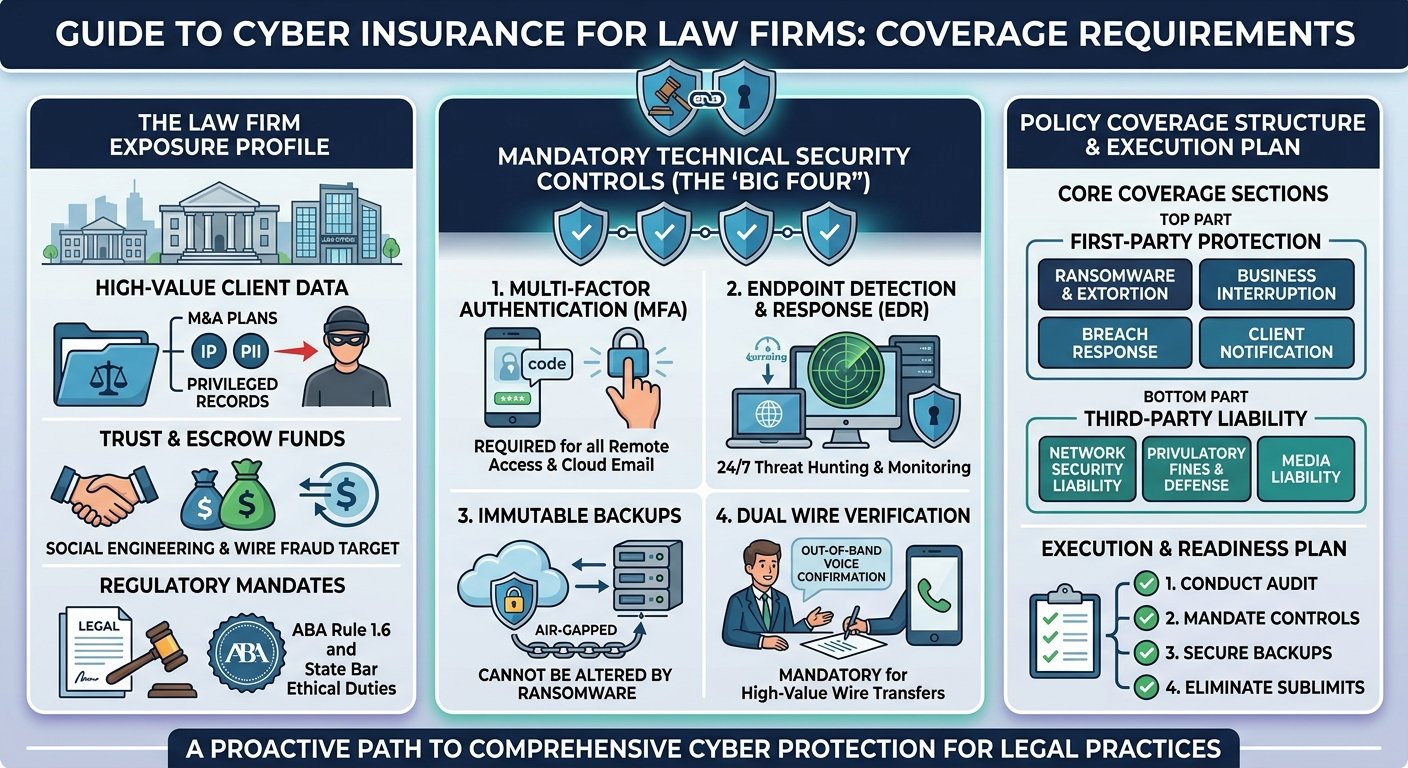
Insurance carriers evaluate legal practices through a unique risk lens compared to standard commercial businesses due to three major factors:
                               ┌── High-Value Confidential Data (M&A, PII, IP, Privileged Records)
                               │
Law Firm Cyber Exposure Risk ──┼── Escrow & Trust Accounts (Wire Fraud & Social Engineering Targets)
                               │
                               └── Regulatory & Ethical Duties (Bar Association Mandates, ABA Rule 1.6)
- High Concentration of Sensitive Data: A breach at a law firm offers cybercriminals a centralized hub of high-value intelligence on hundreds of clients simultaneously.
- Wire Fraud and Trust Account Risk: Real estate, corporate, and estate planning firms regularly handle large financial transactions. Cybercriminals target these firms using Business Email Compromise (BEC) to divert funds from escrow or trust accounts.
- Strict Ethical and Regulatory Mandates: Under ABA Model Rule 1.6(c) and state bar regulations, attorneys have a strict duty to make reasonable efforts to prevent unauthorized access to client information. A breach triggers strict reporting obligations, potential bar disciplinary actions, and client lawsuits.
2. Mandatory Cyber Insurance Requirements for Law Firms
To qualify for a comprehensive cyber insurance policy, underwriters require law firms to prove that specific cybersecurity controls are active across their IT environment.
The table below outlines the core requirements underwriters mandate before binding coverage:
| Cybersecurity Control Requirement | Industry Benchmark Standard | Impact of Non-Compliance |
| Multi-Factor Authentication (MFA) | Mandated across all remote access, cloud email (O3365/Google Workspace), administrative accounts, and core legal databases. | Immediate application rejection or total exclusion for ransomware claims. |
| Endpoint Detection & Response (EDR) | Centralized 24/7 endpoint protection with behavioral monitoring across all firm laptops, servers, and workstations. | Higher premiums and lower liability limits. |
| Immutable & Air-Gapped Backups | Daily encrypted backups stored offsite, air-gapped, or immutable (cannot be altered or deleted by ransomware). | Exclusion of ransomware extortion reimbursement or high deductibles ($50,000+). |
| Wire Transfer Authentication Procedures | Dual-person authorization and out-of-band voice verification for all outgoing wire transfers exceeding set thresholds (e.g., $5,000). | Full exclusion or strict sublimits (e.g., $50,000 max) on Social Engineering/Funds Transfer Fraud. |
| Security Awareness & Phishing Training | Regular (monthly/quarterly) automated phishing tests and mandatory training for all partners, associates, and support staff. | Restricted policy limits for phishing and BEC losses. |
| Patch & Vulnerability Management | Policy requiring critical security patches to be deployed within 14–30 days of release. | Unpatched vulnerability exclusions attached to policy. |
3. Core Coverage Sections Every Law Firm Needs
A robust law firm cyber insurance policy is divided into two primary coverage pillars: First-Party Coverage (direct financial losses incurred by the firm) and Third-Party Coverage (legal defense and liability for damages owed to clients or third parties).
                                  ┌── First-Party Coverage (Breach Response, Extortion, Lost Income)
                                  │
Law Firm Cyber Insurance Policy ──┤
                                  │
                                  └── Third-Party Coverage (Client Lawsuits, Regulatory Fines, Defense Costs)
First-Party Coverages
- IT Forensics & Breach Response: Covers the cost of hiring cybersecurity experts to investigate the source of the breach, contain the threat, and restore compromised systems.
- Ransomware & Cyber Extortion: Reimburses negotiation costs, incident management expenses, and extortion payments (where legally permissible) required to decrypt systems.
- Business Interruption & Extra Expense: Reimburses lost fee revenue and ongoing operational expenses if a cyberattack forces the firm offline.
- Client Notification & Credit Monitoring: Pays for mandatory legal notification letters to affected clients and credit/identity monitoring services.
- Funds Transfer Fraud & Social Engineering: Protects against losses when an employee is tricked by a fraudulent email into wiring client or firm funds to an attacker’s account.
Third-Party Coverages
- Network Security & Privacy Liability: Covers legal defense costs, settlements, or court judgments if clients sue the firm for exposing confidential records or privileged communication.
- Regulatory Fines & Defense: Covers legal fees and penalties assessed by government regulators or state bar entities following a privacy breach.
- Media Liability: Protects against copyright infringement, defamation, or libel claims arising from digital publishing or firm website content.
4. Key Exclusions & Coverage Pitfalls in Law Firm Policies
When reviewing cyber insurance quotes, law firm management must watch for restrictive policy language and sublimits that can leave significant coverage gaps.
                  Common Coverage Pitfalls to Avoid

  ┌───────────────────────────┬───────────────────────────┐
  ▼                           ▼                           ▼
Social Engineering          Unpatched System            Wire Fraud Out-of-Band
    Sublimits                  Exclusions               Verification Clauses
  (e.g., $100k cap on       (Denies claims if          (Requires written proof
   $2M wire losses)          patch was >30 days old)     of phone confirmation)
- Social Engineering Sublimits: Many base policies limit coverage for wire transfer fraud to $50,000 or $100,000, even if the total policy limit is $5,000,000. Firms handling high-value escrow or real estate transactions must negotiate dedicated endorsements matching their wire risk exposure.
- Strict Verification Clauses: Insurers often insert language stating that funds transfer fraud is only covered if the firm followed written out-of-band verification procedures (e.g., calling the recipient using a verified phone number prior to transferring funds). Failure to document this verification can result in a claim denial.
- Unpatched Vulnerability Exclusions: Carriers may deny claims if a breach exploited a known critical software vulnerability for which a patch had been available for more than 30 or 60 days.
- War & Nation-State Attack Exclusions: As cyberwarfare evolves, carriers are tightening language surrounding cyberattacks launched or sponsored by sovereign nation-states. Ensure your broker negotiates clear carve-outs for commercial cyber extortion.
5. Step-by-Step Execution Plan to Get Cyber Insurance
To secure the broadest coverage at competitive rates, law firms should follow a structured readiness path 60 to 90 days prior to policy inception or renewal:
[1. Conduct Internal Technical Security Audit]
                       │
                       ▼
[2. Mandate MFA & EDR Across All Remote Access & Email]
                       │
                       ▼
[3. Formalize Written Wire Transfer & Vendor Protocols]
                       │
                       ▼
[4. Partner with a Specialized Commercial Insurance Broker]
                       │
                       ▼
[5. Complete Application & Underwriting Interview]
- Audit Technical Controls: Ensure MFA is enforced 100% across all user accounts, cloud apps, VPNs, and remote desktops. Exceptions for senior partners are the #1 reason applications are flagged or rejected.
- Review Wire Transfer Policies: Establish a mandatory, dual-authorization policy requiring independent phone verification for any change in payment instructions or wire requests.
- Test Backup Restoration: Regularly test restoring critical practice management software and client documents from offline or immutable backups to verify business continuity readiness.
- Work with a Specialist Broker: Partner with a broker experienced in legal professional liability and cyber insurance who understands underwriting expectations.
Summary Checklist
- MFA is Non-Negotiable: Enforce Multi-Factor Authentication everywhere across the firm’s network.
- Protect Trust Accounts: Implement strict written out-of-band phone verification protocols for wire transfers.
- Secure Backups: Store backups offsite in an immutable, air-gapped environment to protect against ransomware.
- Eliminate Sublimits: Negotiate higher limits for Funds Transfer Fraud and Social Engineering to match typical transaction sizes.