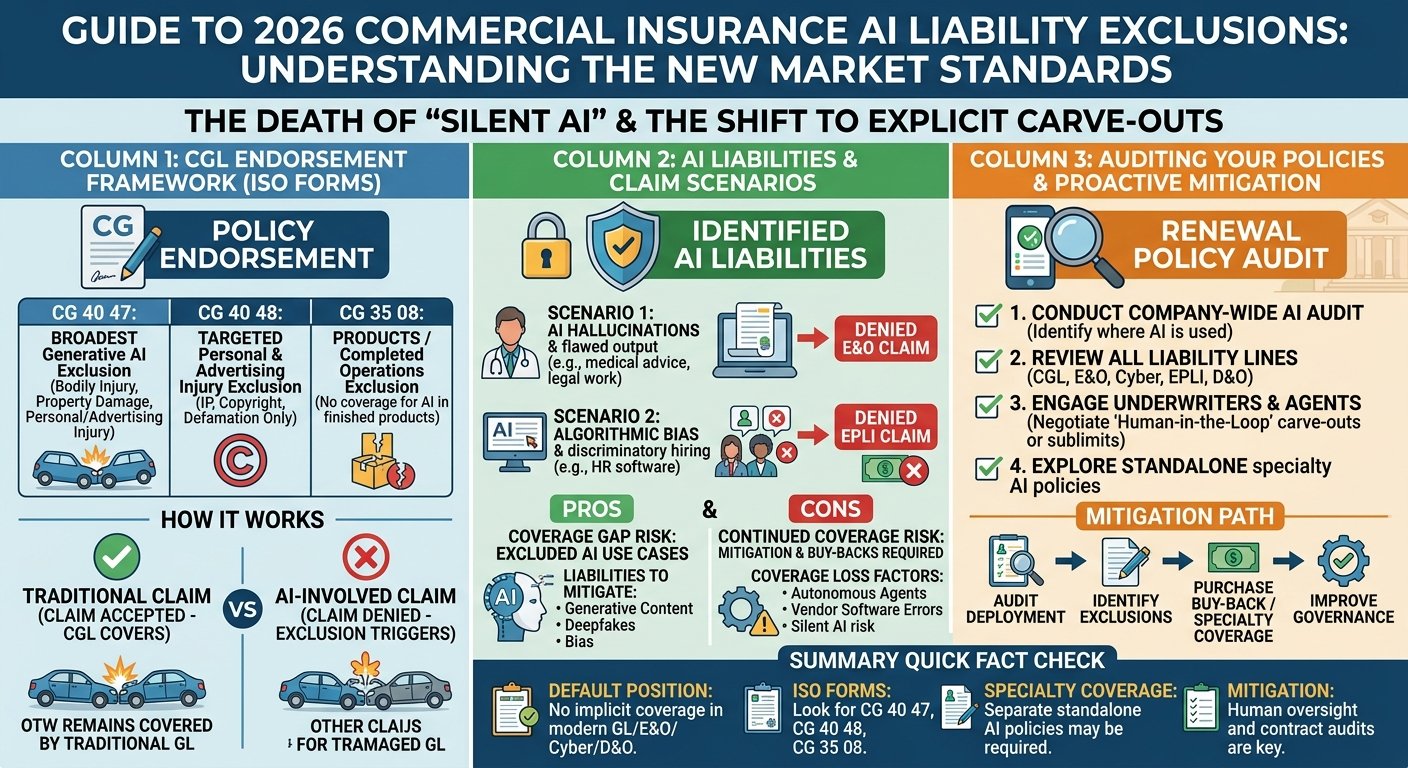
The Complete Guide to Commercial Insurance AI Liability Exclusions
The rapid adoption of generative tools, machine learning models, and autonomous AI agents across corporate operations has radically altered commercial liability exposure. Businesses leverage AI to generate marketing copy, write code, automate underwriting, screen job applicants, and control industrial machinery.
However, this shift has brought severe exposures: AI hallucinations, copyright infringements, algorithmic bias, systemic cyber breaches, and autonomous operational failures.
To mitigate unquantifiable exposure, commercial insurers shifted from treating artificial intelligence as a vague coverage uncertainty (“Silent AI”) to explicitly carving it out.
Beginning with standard forms released by the Insurance Services Office (ISO)—such as CG 40 47, CG 40 48, and CG 35 08—carriers across Commercial General Liability (CGL), Professional Liability (E&O), Directors & Officers (D&O), and Employment Practices Liability (EPLI) are attaching explicit AI Liability Exclusions at renewal.
This guide explores how these exclusions work, their structural variations, affected coverage lines, real-world claim scenarios, and strategies corporate policyholders can use to bridge coverage gaps.
1. The Death of “Silent AI” and the Shift in Risk
Historically, standard commercial policies did not explicitly mention “artificial intelligence.” Policyholders relied on this silence, assuming that if an AI tool generated content that caused a defamation lawsuit, or if an automated system caused property damage, their existing policies would respond under standard Coverage A (Bodily Injury & Property Damage) or Coverage B (Personal & Advertising Injury).
Insurers faced an “actuarial blind spot” similar to the early days of cyber liability:
                               ┌── Traditional Risk (Linear, localized, predictable statistics)
                               │
Commercial Underwriting Risk ──┤
                               │
                               └── AI Risk (Systemic, correlated, scalable catastrophic losses)
Why Insurers are Adding AI Exclusions
- Correlated Systemic Losses: If thousands of businesses rely on a single foundation model or automated cloud software, an error in that core algorithm can trigger millions of simultaneous liability claims globally, threatening insurer solvency.
- Lack of Historical Actuarial Data: Machine learning systems evolve dynamically, making historical loss records unreliable predictors of future liability.
- Unclear Causal Chains: Determining whether an injury was caused by human error, vendor algorithm flaws, or autonomous system drift complicates traditional subrogation and claims defense.
2. Key ISO Endorsements in Commercial General Liability (CGL)
The most prominent developments in commercial AI exclusions are the standardized ISO endorsements introduced for Commercial General Liability (CGL) policies.
                     ISO Generative AI Exclusion Framework
                                       │
        ┌──────────────────────────────┼──────────────────────────────┐
        ▼                              ▼                              ▼
    CG 40 47                       CG 40 48                       CG 35 08
  Broadest Form                  Narrow Form                   Products/Completed
(Coverage A & B)               (Coverage B Only)               Operations Only
Breakdown of Standard ISO Endorsements
| Endorsement Form | Scope of Exclusion | Excluded Coverage Sections | Key Impact on Policyholder |
| CG 40 47 | Total Generative AI Exclusion | Coverage A (Bodily Injury / Property Damage) & Coverage B (Personal & Advertising Injury) | Removes all GL coverage for losses arising directly or indirectly from generative AI. |
| CG 40 48 | Personal & Advertising Injury Exclusion | Coverage B Only | Targeted exclusion removing coverage for copyright infringement, IP theft, defamation, and privacy claims caused by AI. Preserves Coverage A bodily injury protection. |
| CG 35 08 | Products & Completed Operations Exclusion | Products/Completed Operations Hazard | Excludes property damage or physical injury resulting from commercial products or completed services incorporating generative AI. |
3. The Spectrum of AI Exclusion Language
Carriers utilize varying degrees of exclusionary language depending on their risk appetite and the insured’s industry sector.
Broadest Exclusion ──────────────────────────────────────────────────► Narrow Exclusion
[Absolute / Absolute AI]      [Autonomous Systems]       [Human-in-the-Loop Preserved]
("arising out of or in         (Excludes fully            (Covers AI used as an
 any way involving")          unsupervised agents)        assisted recommendation tool)
1. Absolute AI Exclusions (“Total Form”)
The broadest forms state that the policy does not apply to any claim, loss, or defense costs “arising out of, resulting from, or in any way involving, directly or indirectly, the use of artificial intelligence.”
- Impact: Even if a human supervisor reviews an AI output before publishing or executing an action, the presence of AI anywhere in the causal chain triggers the exclusion.
2. Autonomous Agent & Oversight Exclusions
Targeted language that distinguishes between fully autonomous software and human-assisted workflow tools.
- Impact: Excludes claims arising when an AI agent acts independently without human review (e.g., auto-executing financial trades or deploying code directly to production). Claims where a human reviews and signs off on the recommendation remain covered.
3. Training & Data Ingestion Exclusions
Designed to address liability surrounding data scraping, copyright violations, and privacy breaches incurred while training internal or custom large language models (LLMs).
4. Impact Across Commercial Lines of Insurance
AI exclusions extend beyond standard General Liability policies into nearly all lines of corporate insurance.
                             Commercial Lines Affected
                                        │
    ┌───────────────────┬───────────────┴───────────────┬───────────────────┐
    ▼                   ▼                               ▼                   ▼
Professional        Employment Practices            Cyber & Tech        Directors & Officers
Liability (E&O)     Liability (EPLI)                Liability           (D&O)
A. Professional Liability / Errors & Omissions (E&O)
- Risk: Law firms, accounting practices, engineering consultancies, and medical providers using AI for decision support.
- Exclusion Trend: Excludes claims stemming from “AI hallucinations,” flawed code generation, or incorrect professional advice derived from automated tools.
B. Employment Practices Liability Insurance (EPLI)
- Risk: Using automated HR software to parse resumes, score candidate interviews, or monitor workplace performance.
- Exclusion Trend: Excludes claims alleging class-action employment discrimination, disparate impact, or systemic bias resulting from automated recruitment algorithms.
C. Cyber & Media Liability
- Risk: Unintended exposure of confidential corporate data or PII through public AI prompts, alongside automated copyright infringement claims.
- Exclusion Trend: Excludes coverage for data breaches occurring through unauthorized third-party model scraping or data ingestion into unapproved LLMs.
D. Directors & Officers (D&O)
- Risk: Executive governance failures, failure to implement corporate AI guardrails, or misrepresenting AI capabilities to investors (“AI Washing”).
- Exclusion Trend: Excludes shareholder suits alleging breach of fiduciary duty arising from failed corporate AI implementations or governance oversights.
5. Real-World Claim Scenarios Impacted by AI Exclusions
To understand how an AI exclusion functions during a loss, consider these real-world business scenarios:
Scenario 1: Marketing Agency & Copyright Infringement
- The Incident: A digital marketing firm uses a generative design tool to create an ad campaign for a client. The tool outputs imagery that infringes on a artist’s copyrighted work, resulting in a $500,000 copyright lawsuit.
- Policy Outcome: Under a standard CGL policy, advertising injury might be covered under Coverage B. However, if endorsement CG 40 47 or CG 40 48 is attached, the carrier denies coverage entirely.
Scenario 2: Automated HR Screening & Disparate Impact
- The Incident: A enterprise company uses an AI candidate-ranking platform to filter 50,000 job applicants. The algorithm penalizes applicants over a certain age bracket, leading to an EEOC class-action lawsuit alleging age discrimination.
- Policy Outcome: If the company’s EPLI policy contains a broad AI & Algorithmic Bias Exclusion, the insurer refuses to pay defense costs or settlement payouts, leaving the employer fully exposed.
Scenario 3: Autonomous Machinery & Property Damage
- The Incident: A logistics warehouse deploys autonomous forklift agents governed by spatial AI. A logic error causes an autonomous vehicle to collision-damage a client’s inventory stack, destroying $300,000 worth of goods.
- Policy Outcome: If the warehouse’s policy carries an Autonomous Operation Exclusion (CG 35 08 or custom form), the property damage claim is denied because the machinery operated without real-time human intervention.
6. How Corporate Policyholders Can Navigate AI Exclusions
As insurers add AI exclusions to standard policies, risk managers and business executives must take proactive steps to maintain protection.
                     Action Plan for Managing AI Risk
                                       │
  ┌───────────────────┬────────────────┴───────────────────┬───────────────────┐
  ▼                   ▼                                    ▼                   ▼
1. Comprehensive    2. Policy Audit                      3. Underwriter      4. Specialty AI
   AI Inventory        & Endorsement Review                 Negotiation         Coverage
Step 1: Conduct a Company-Wide AI Audit
Map every operational area where automated algorithms, LLMs, vendor tools, or autonomous agents are deployed:
- Is AI customer-facing?
- Is AI generating professional work product or code?
- Are HR or hiring decisions automated?
- Is proprietary or sensitive client data being entered into external tools?
Step 2: Perform a Renewal Policy Audit
Examine the schedule of endorsements on every policy renewal (CGL, E&O, Cyber, EPLI, D&O). Look for forms starting with CG 40 47, CG 40 48, CG 35 08, or custom carrier exclusions using terms like “generative modeling,” “algorithmic decisioning,” or “artificial intelligence.”
Step 3: Negotiate Exclusions During Placement
Insurance terms are negotiable during renewal:
- Carve-Outs: Request that insurers carve out human-reviewed AI processes (“Human-in-the-Loop”) from absolute exclusions.
- Sublimits: If a full buy-back of AI coverage is unavailable, negotiate a sublimited endorsement specifically for AI-related personal injury or advertising claims.
Step 4: Purchase Standalone Specialty AI Insurance
For enterprises heavily reliant on proprietary AI infrastructure, the traditional market may no longer offer adequate standard coverage. Specialty insurance providers offer dedicated Standalone AI Liability Policies covering algorithmic error, model performance failures, IP infringement, and regulatory fines.
Summary Checklist
- Default Position: Standard commercial general liability policies no longer offer implicit coverage for AI claims.
- Watch Out For: Endorsements CG 40 47, CG 40 48, and CG 35 08 on CGL policies.
- Inspect All Lines: Check for AI exclusionary language in E&O, EPLI, Cyber, and D&O policies.
- Mitigation Strategy: Maintain strict human-in-the-loop oversight, audit vendor contracts, and explore standalone AI liability coverage.