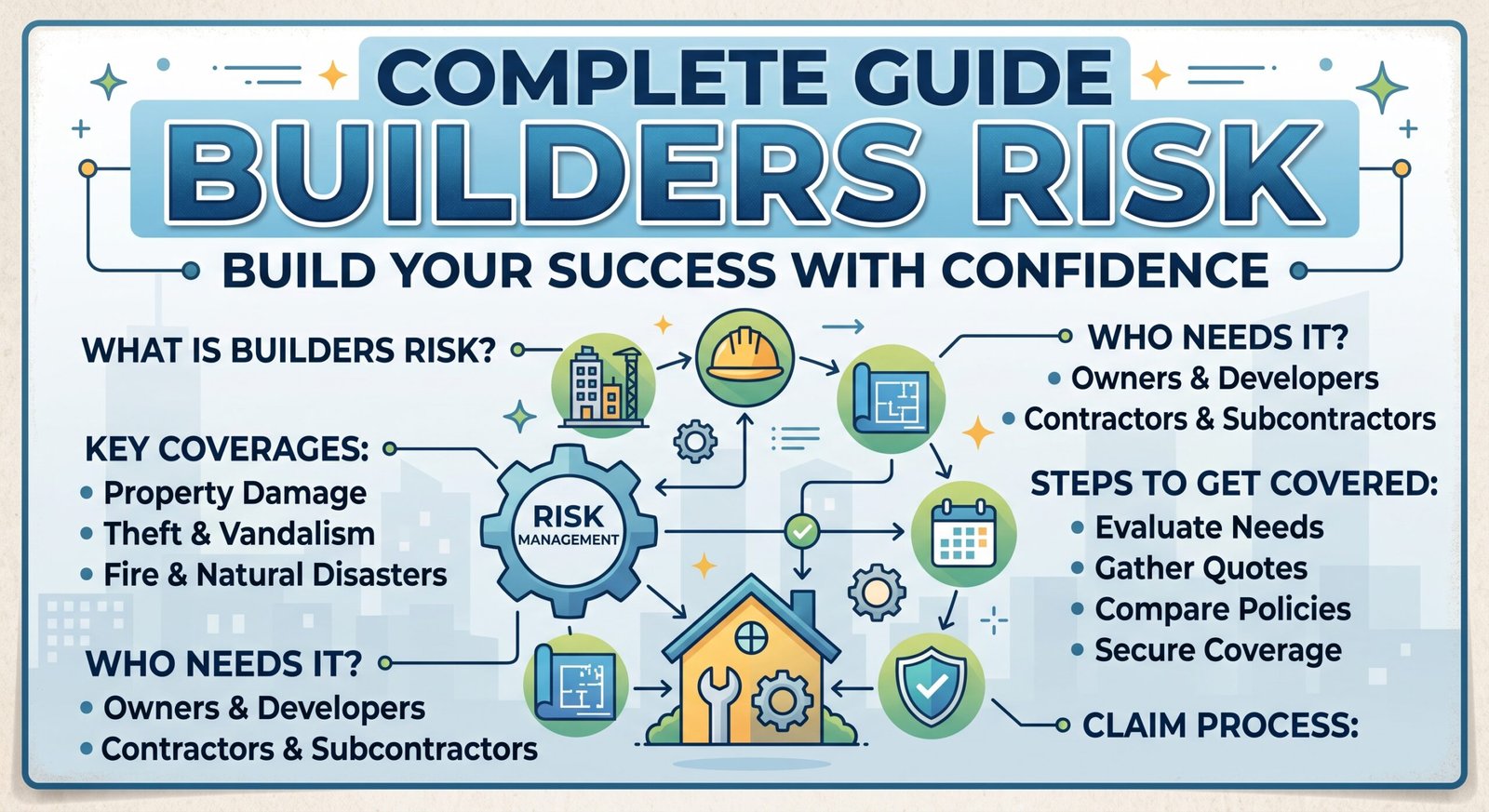
Complete Guide: Builders Risk Insurance for New Commercial Construction
Commercial construction projects are complex, high-stakes investments involving heavy capital outlay, intricate logistics, and multi-layered risks. Builders Risk Insurance (also known as Course of Construction Insurance or Contractor’s All Risks Insurance) is a specialized property insurance policy engineered specifically to protect buildings, fixtures, raw materials, and machinery while construction or major renovation is underway.
What is Builders Risk Insurance?
Builders Risk Insurance is a temporary, non-standard property policy designed to indemnify owners, general contractors, and financiers against direct physical loss or damage to a structure in progress. Unlike standard commercial property insurance—which covers completed and operational buildings—builders risk policies address the unique exposures of a structure that is incomplete, structurally vulnerable, and exposed to external elements, jobsite accidents, and vandalism.
The policy coverage attaches at the inception of the construction schedule (or when materials are delivered to the site) and terminates once the structure is completed, handed over, or occupied.
Core Parties Protected Under the Policy
A commercial builders risk policy typically lists multiple stakeholders as named insureds or additional insureds to eliminate finger-pointing and subrogation disputes following a loss:
- Project Owner / Real Estate Developer: Holds direct insurable financial interest in the asset and protects funded equity.
- General Contractor (GC): Liable for site execution, materials handling, and physical site security under the prime contract.
- Subcontractors & Trade Crews: Covered for work installed or materials handled on-site prior to milestone acceptance.
- Lenders & Financial Institutions: Added as loss payees to safeguard capital loans and debt service.
- Architects & Structural Engineers: Frequently covered under specific endorsement extensions for project specs, plans, and drawings stored on-site.
What Does Commercial Builders Risk Cover?
Most commercial builders risk contracts are written on an “All-Risk” (Open Perils) form. This means all direct causes of physical loss are covered unless explicitly excluded in the policy jacket.
| Category | Typical Covered Items / Scenarios |
| Physical Structure | Foundations, load-bearing walls, structural steel, roofs, MEP systems (mechanical, electrical, plumbing), and fixtures. |
| Raw Materials & Supplies | Lumber, HVAC units, glass panes, drywall, and structural elements on the jobsite, in transit, or staged off-site. |
| Temporary Works | Scaffolding, concrete forms, falsework, job trailers, perimeter hoardings, and temporary power setups. |
| Standard Covered Perils | Fire, lightning strikes, explosion, windstorms, hail, vandalism, civil commotion, and theft of installed physical assets. |
| Soft Costs (Delay Costs) | Additional loan interest, architect and re-design fees, permit renewals, extended equipment rentals, real estate taxes, and legal retainers. |
Critical Endorsements for Commercial Construction
Standard baseline coverage is rarely sufficient for multi-million-dollar commercial ventures. Commercial contractors and owners routinely secure specialized extensions:
- Delay in Completion & Soft Costs: If an insured peril (like a major framing fire) delays project delivery by five months, this rider pays carrying costs, extended loan interest, and lease renegotiation expenses.
- Loss of Business Income / Advance Loss of Profits (ALOP): Covers projected rental income or operating revenue lost due to delayed opening dates caused by a covered physical loss.
- Materials in Transit and Off-Site Storage: Protects customized items (e.g., custom chillers, elevators, imported marble) while stored in warehouses or moved on flatbeds.
- Debris Removal and Pollutant Clean-up: Covers the substantial cost of clearing charred structural steel, concrete debris, or hazardous soil runoffs following a catastrophe.
- Water Damage & Sewer Backup: While subterranean ground seepage is excluded, sudden discharge, pipe ruptures, or city main backups require explicit endorsements.
- Ordinance or Law: Pays the extra cost required to rebuild to new building codes or local municipal zoning laws enacted during the reconstruction phase.
- Earth Movement & Flood (DIC Policies): Standard policies exclude earthquakes, sinkholes, and rising surface water; these require specialized Difference-in-Conditions (DIC) riders.
Common Exclusions
Builders risk insurance is not an all-encompassing warranty. Standard exclusions include:
- Faulty Workmanship, Design, or Materials: The policy covers resultant damage (e.g., a collapse caused by poor design), but will not pay to fix the architect’s flawed blueprint or replace poorly poured concrete itself (unless written with broad London Market clauses like LEG 3 or DE5).
- Contractual Penalties & Liquidated Damages: Late delivery penalties imposed by contract terms are generally uninsurable under standard property forms.
- Contractor Equipment and Tools: Heavy earthmovers, excavators, cranes, and handheld power tools are covered under an Inland Marine / Contractor’s Equipment Floater, not builders risk.
- Employee Theft & Dishonesty: Missing inventory or raw materials stolen by employees require commercial crime coverage.
- Wear, Tear, and Gradual Rust: Inherent vice, natural oxidation, or rot over time.
- Nuclear Hazards, Acts of War, and Government Seizure: Universal exclusions across standard commercial lines.
Builders Risk vs. General Liability vs. Commercial Property
A common oversight is assuming general liability covers physical jobsite assets. The three policies serve completely separate functions:
| Policy Type | What It Covers | Who It Pays |
| Builders Risk Insurance | Direct physical damage to the structure, site, and building materials during construction. | First-party claim (pays the policyholder/owner/lender). |
| Commercial General Liability (CGL) | Third-party bodily injury and property damage resulting from jobsite operations (e.g., a falling beam crushes a pedestrian’s car). | Third-party liability claims. |
| Permanent Commercial Property | Fully completed, operational, and occupied commercial structures. | First-party property claim once construction ends. |
Cost Factors and Valuation for Commercial Builds
Builders risk premiums typically range from 1% to 4% of total construction project costs, depending on risk density.
Total Insurable Value = Hard Costs (Materials + Labor) + Soft Costs (Financing + Fees)
Key underwriting variables include:
- Construction Class: Fire-resistive concrete and structural steel builds (ISO Class 4-6) receive substantially lower rates than combustible wood-frame builds (ISO Class 1-2).
- Geographic Exposures: Proximity to coastal hurricane paths, wildfire zones, or seismic fault lines drives up deductibles and premiums.
- Site Security Measures: 24/7 video monitoring, lighted perimeters, automated fire break detection, and gated security access significantly reduce risk surcharges.
- Project Duration & Phasing: Projects structured over 24+ months require extended policy terms and built-in inflation buffers for material costs.
- Deductibles: Commercial deductibles usually scale from $10,000 for standard perils up to $100,000+ for water damage, flood, or windstorm events.
When Does Coverage Start and Cease?
Strict timing triggers dictate policy validity:
- Inception: The policy must take effect before or as soon as materials arrive on-site or ground is broken. Procuring a policy after construction has significantly progressed often requires tedious site audits and higher premiums.
- Termination: Coverage ceases automatically upon the occurrence of any of the following milestones:
- The property is occupied in whole or in part without carrier sign-off.
- The project owner formally accepts the completed building.
- A Certificate of Occupancy (CO) is granted.
- The policy expiration date is reached (unless an extension is formally granted).
- The project is abandoned for longer than the policy’s idle-work threshold (often 30–60 consecutive days).