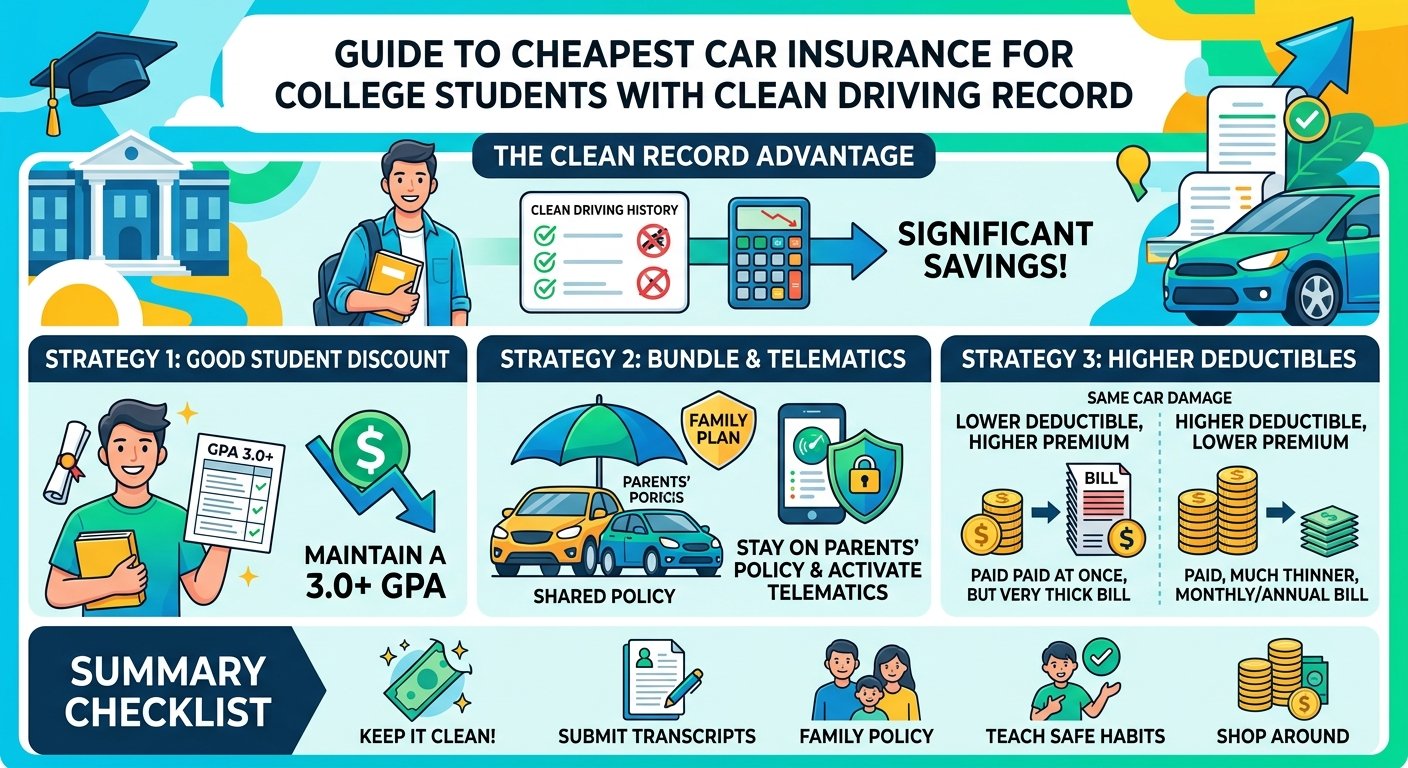
The Ultimate Guide to the Cheapest Car Insurance for College Students with a Clean Driving Record
Securing affordable car insurance as a college student can often feel like an uphill battle. Insurance companies naturally categorize young drivers (ages 18 to 24) into a High-Risk Category due to their limited time behind the wheel. However, having a clean driving record—free of accidents, speeding tickets, or traffic violations—serves as your single greatest asset in driving those premium rates down.
This comprehensive guide breaks down how college drivers can leverage a spotless driving history, take advantage of specific student discounts, and select the right coverage options to secure the lowest possible rates.
1. Understanding the College Student Risk Profile
Insurance pricing is governed by Actuarial Science—the mathematical calculation of risk based on historical data. Key factors impacting college students include:
- Limited Driving Experience: Young drivers have fewer accumulated hours on the road, making statistical accident rates higher.
- Higher Claim Frequencies: Statistically, drivers under 25 file insurance claims more frequently than older age brackets.
- Financial Liabilities: Vehicle repair costs, medical expenses, and legal liability claims escalate the potential cost of an accident.
The Power of a Clean Driving Record
A clean driving log signals to insurers that you are a responsible operator despite your age group. Maintaining a record free of infractions can unlock 15% to 35% in discounts, lowering your premiums closer to those of experienced adult drivers.
2. Dynamic Car Insurance Rates Comparison
The table below illustrates how a clean driving record dramatically improves insurance costs compared to high-risk profiles and adult baselines.
| Driver Category | Annual Premium Rate (% of Vehicle Market Value) | Estimated Annual Premium ($25,000 Vehicle Value) | Primary Risk Profile |
| College Student (Clean Record) | 3.5% – 5.0% | $875 – $1,250 | Low driving experience, offset by safe history and student discounts. |
| College Student (With Violations/Claims) | 7.0% – 10.0% | $1,750 – $2,500+ | High risk due to clean record loss, traffic citations, or fault accidents. |
| Experienced Driver (Age 30+) | 2.5% – 3.5% | $625 – $875 | High experience, low claim frequency, established credit/driving history. |
3. Top Strategies & Discounts for College Students
Good Student Discount (Academic Performance)
Insurers consistently reward high academic achievers because statistics indicate academically disciplined students demonstrate safer behavior on the road.
- Requirement: Maintain a GPA of 3.0 or higher (B average or higher).
- Savings Potential: 8% to 15% off the total annual premium.
- Proof Required: A recent official transcript or report card certified by your registrar.
Household / Multi-Vehicle Policy Inclusion
Purchasing an independent policy as a single young driver is almost always the most expensive path.
- Shared Parent Policy: Staying listed as a “Named Driver” under a parent or guardian’s existing policy leverages their multi-car and multi-policy discounts.
- Savings Potential: Can cut young driver insurance costs by up to 40% compared to a standalone individual policy.
Telematics & Usage-Based Insurance (UBI)
Telematics programs utilize a mobile app or a small plug-in device to monitor real-time driving habits.
- Tracked Metrics: Smooth braking, controlled acceleration, adherence to speed limits, and time of day (avoiding late-night driving).
- Savings Potential: Consistently clean driving habits can generate immediate discounts ranging from 10% to 25%.
Higher Deductibles
A deductible is the out-of-pocket amount you agree to pay before the insurance policy covers damages.
- Mechanism: Increasing your deductible (e.g., from $500 to $1,000) reduces the insurer’s payout risk, which immediately lowers your recurring monthly or annual premium.
- Strategy: Keep your deductible at an amount you can easily afford in cash out of an emergency fund.
4. Selecting the Right Coverage Type
                               ┌── Comprehensive Coverage (Collision + Full Risk Protection)
                               │
Student Insurance Options ─────┼── Theft & Total Loss Protection (Mid-tier option)
                               │
                               └── Third-Party Liability Only (State Legal Minimum)
- Comprehensive & Collision Coverage: Covers repairs for your vehicle regardless of who caused the accident, as well as non-collision damage (vandalism, extreme weather, theft). Recommended for newer vehicles or financed cars.
- Third-Party Liability Only: Covers property damage and bodily injuries caused to other people in an accident where you are at fault. This is the cheapest option and ideal for older, low-value vehicles where repairing the car would cost more than its market value.
5. Step-by-Step Action Plan to Get Covered
[Gather License & Vehicle Registration Documents]
                       │
                       ▼
[Collect Academic Records for Good Student Discount]
                       │
                       ▼
[Compare Quotes Across at Least 3 Major Insurers]
                       │
                       ▼
[Select Policy & Install Telematics App for Extra Savings]
- Audit Your Documents: Ensure your driver’s license, vehicle title, and academic transcript (GPA 3.0+) are ready.
- Compare Multiple Insurance Quotes: Get quotes from multiple providers to identify competitive rates for college drivers.
- Apply Student Discounts: Ensure good student, driver’s education, and safe driver discounts are actively applied to your quote.
- Finalize and Confirm: Choose your preferred deductible, sign the policy documents, and enroll in any voluntary telematics programs to maximize long-term savings.
Summary Checklist for Maximum Savings
- Keep your record spotless: Avoid minor traffic infractions and speeding tickets.
- Submit academic transcripts: Provide proof of a 3.0+ GPA every semester.
- Stay on a family policy: Remain on a parent/guardian policy whenever possible.
- Opt for telematics tracking: Use driver-monitoring apps to prove safe habits.
- Shop around annually: Re-evaluate quotes every 6 to 12 months as your driving experience grows.